Student’s success is not only determined by how rigorous the programs are. They are external factors that may contribute positively or negatively. In this investigation, I try to make connections to these external factors that I believe impact student success.
I will use a random sample of 300 observation since the data set is huge.
Attendance
If students do not attend class, there is a chance that some content will be hard for them to grasp. To look into attendance we have to also look into things that may affect it. An example is Netflix hours.
In this scatter plot, we can see that although the attendance level is varied across the y-axis, as the number of hours spent on Netflix increase, the number of students decrease. Which mean that Netflix can affect attendance.
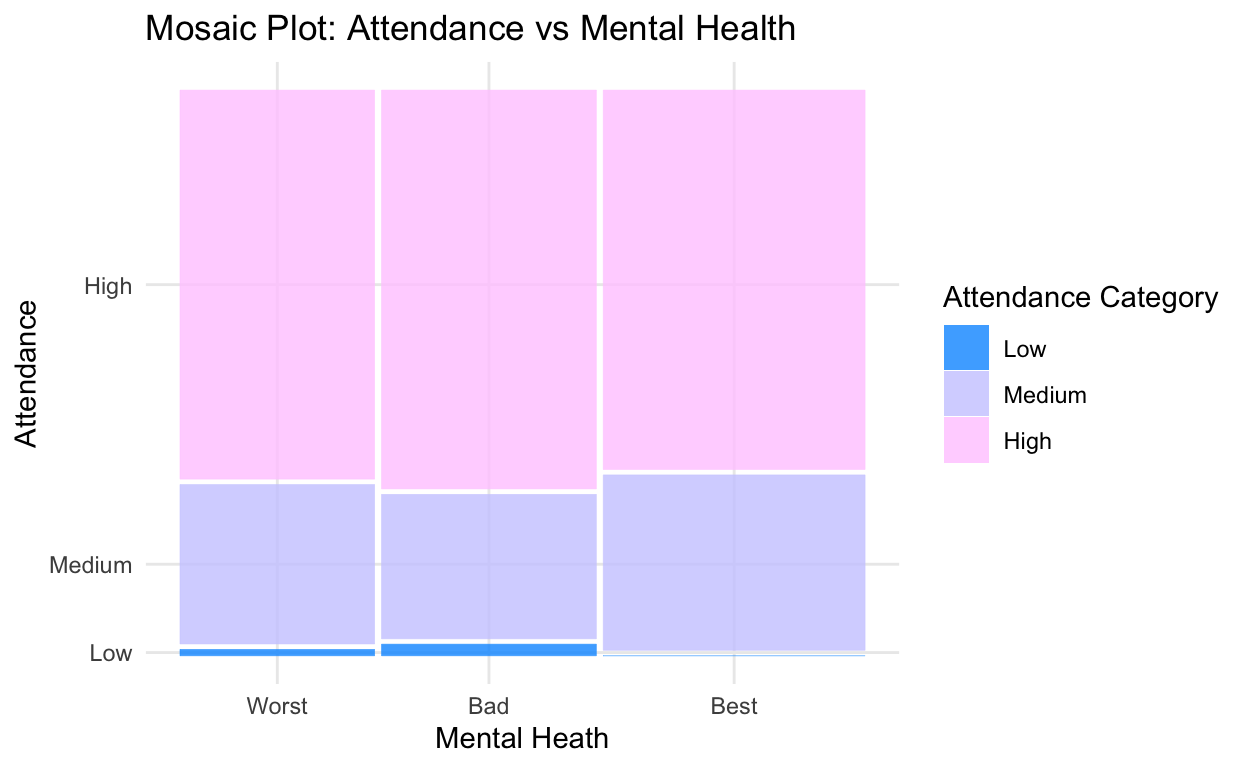
By observing the width of the bins above in the mosaic graph, with worst and bad mental health we see some low attendance. This emphasizes my assumptions at the beginning. It is worth noting that sometimes students choose not to report their mental health status at the extremities which might be why we have a higher number in the middle.
Mental Health
Mental health is also a big thing in our daily lives. Students can’t do well in school when they are unwell mentally. I believe that exercise rate can impact the mental well being of students.
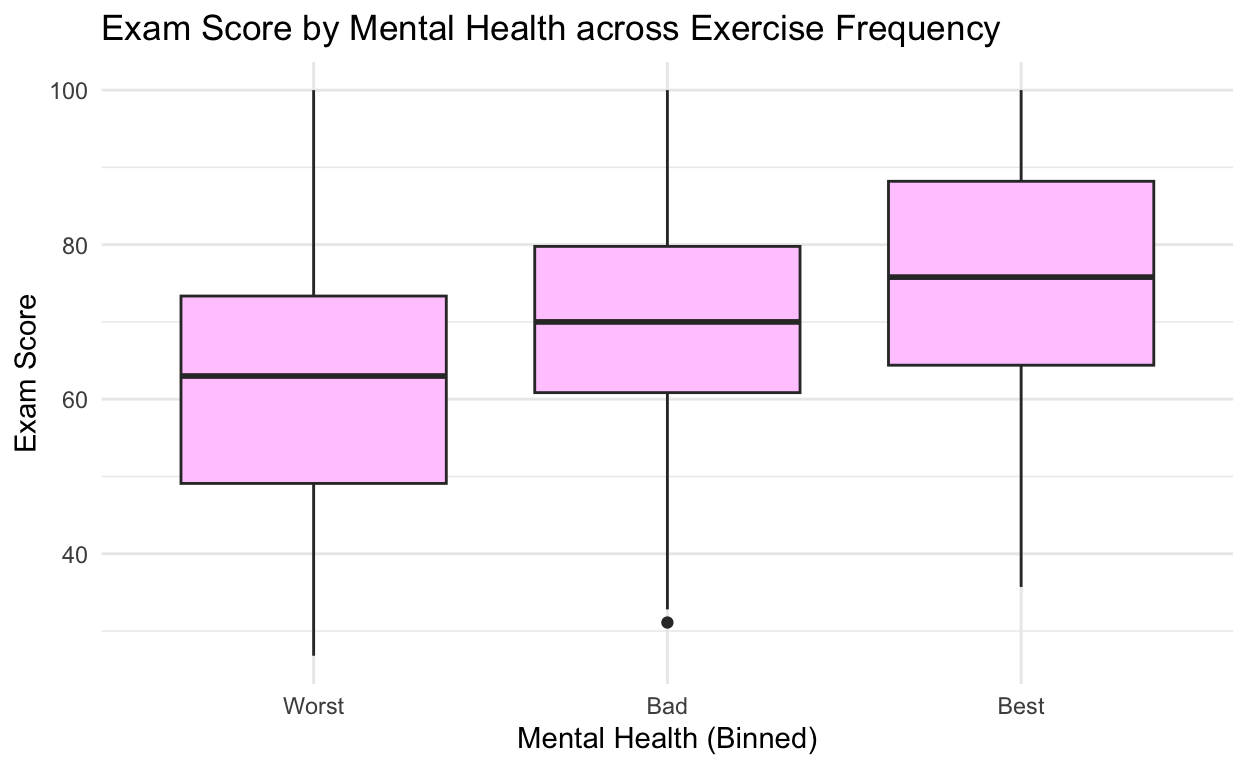
From the above box plot, we can identify an upward trend. The median of the right most boxplot is higher than those of the two before it. This is a good indication that the better the mental health, the more likely students are to get good scores in exams.
Studying Hours
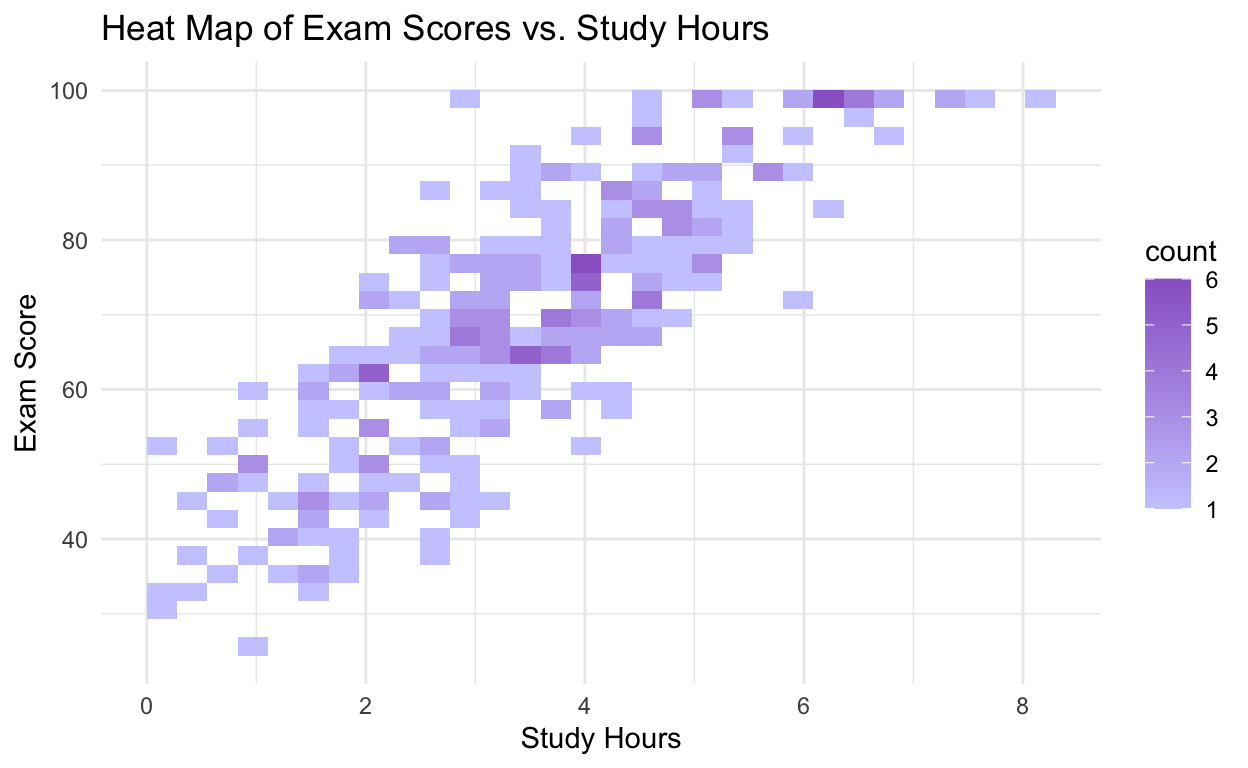
From the heat map, we can see a positive correlation between study hours and exam score. Students who put in more hours to study get better grades. This can be used to emphasize the importance of revision after class. Lecture alone is not enough to succeed.
Exercising
Last but not least, I believe that exercising not only keep our bodies healthy, but also help us feel relaxed and reset for better studying conditions. In the following barchart, I will be trying to see the performance of students based on their exercising and mental health rating.
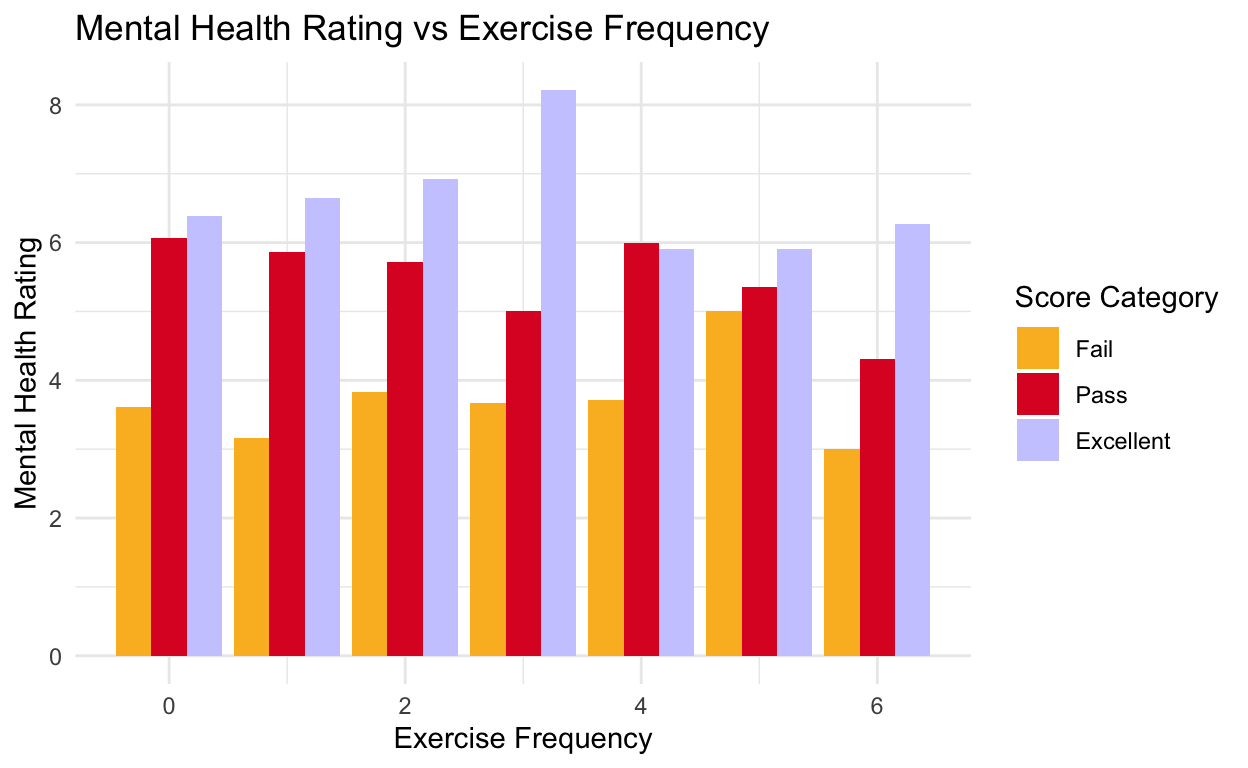
The above bar chart does tell much. My hypothesis was that students who exercise more tend to have a better mental health and a high academic performance. In my data, we see a spike for students who exercise three times a week. This might also be due to the false reports on mental health as mentioned above.
Conclusion
In this investigation, I was interested in identifying habits that might affect student’s performance. What I found to be true was that the amount of hours that students dedicate to studies can significantly improve their grade. Moreover, students who spend much time on Netflix and those with an unstable mental health, do not perform well in class.
It is important for every student to access themselves and see if these findings apply to them, to make informed decisions for the future.